Climate Proofing Was Always a Lie
The implication of a known target, a stable endpoint and durable protection is false. It always was. It didn't take me long to find out who the brains behind one of the most disingenuous concepts in climate adaptation were: a bank.

I remember clearly the first time I heard the term "climate proofing", because for a moment, my brain pressed pause, and in a split second, years of training as a climate scientist fuelled a visceral reaction in an early morning meeting at the Directorate-General for Climate Action, with colleagues from the European Commission, in Brussels: "what are you talking about? what the hell is climate proofing?"
Later that night, after dinner, I sat down in front of my computer and decided to hunt down who coined such a disingenuous concept... It didn't take me long to find out who the brains behind one of the biggest hallucinations in climate adaptation were: a bank, in this case, the Asian Development Bank. Prepared under a regional technical assistance project, closely associated with lead researcher John E. Hay, the report applies the term systematically to infrastructure, communities, and national planning in Pacific island countries, defining climate proofing as "identifying climate-related risks and reducing them to acceptable levels through changes in planning, design, construction, and operation".
Oh, my, word.
"Climate proofing” sounds reassuring (and I suspect, deliberately so). It promises that with enough engineering, planning, and investment we can harden cities, farms, coasts, and supply chains against the climate of the future. This is much like waterproofing a basement or fireproofing a building. The term implies a known target, a stable endpoint, and the possibility of durable protection. That implication is false. It always was.
Three recent papers help us expose why climate proofing is, and always was, a complete misnomer.
First, the very science we would use to define the “climate” we are proofing against is in crisis. Shaw and Stevens (2025) argue that the dominant paradigm of climate science is breaking down. This paradigm applies physical laws under the assumption that large and small scales cleanly separate. Large-scale features were predicted successfully. Regional signals, the ones that actually hit infrastructure and communities, increasingly diverge from expectation. When the foundational tools for projecting the local climate conditions that “proofing” requires are themselves under strain, the idea of designing permanently against a known future becomes incoherent. We are not, and never were, building against a fixed threat. We are building amid unresolved scientific anomalies.
Second, the magnitude of the threat has been systematically underestimated. Myhre and colleagues (2025) show that climate models with low sensitivity cannot reproduce the observed strengthening of Earth’s energy imbalance over the past two decades. Low-sensitivity futures are effectively ruled out. The climate we thought we were preparing for is milder than the one now emerging. “Proofing” against an optimistic range is not resilience. It is, at best, miscalibration.
Third, the pathways themselves are not reversible in the way planners may have assumed. Schleussner et al. (2024) demonstrate that overshoot does not return the world to an equivalent state. Overshoot means temporarily exceeding temperature targets and then trying to come back down - a gamble so many times promoted by so many of the mandarins at COPs (ipse vidi). Regional risks, sea-level trajectories, cryosphere losses, and residual impacts differ fundamentally from those in a world that never exceeded the limit. Large-scale carbon dioxide removal sufficient to reverse overshoot may be geophysically, technically, and sustainably unachievable. The future climate is not a temporary deviation from which we can return to a known baseline. It is a path-dependent, potentially irreversible reorganization.
What remains necessary is not proofing but continuous, humble adaptation under deep uncertainty. This must be paired with the only action that still alters the trajectory. That action is rapid, deep cuts in emissions. Anything that sells the former as a substitute for the latter is not strategy. It is disingenuous marketing.
Taken together, these three papers dismantle the foundations on which climate proofing rests. Shaw and Stevens show that the science required to define the local conditions we would design against is itself in deep crisis. Regional signals no longer behave as the standard paradigm predicted. Myhre and colleagues demonstrate that the overall magnitude of change is likely greater than the lower-sensitivity futures many plans still assume. Schleussner and colleagues establish that the pathways themselves are path-dependent and only partially reversible. Post-overshoot climates are not equivalent to climates that never exceeded the limit.
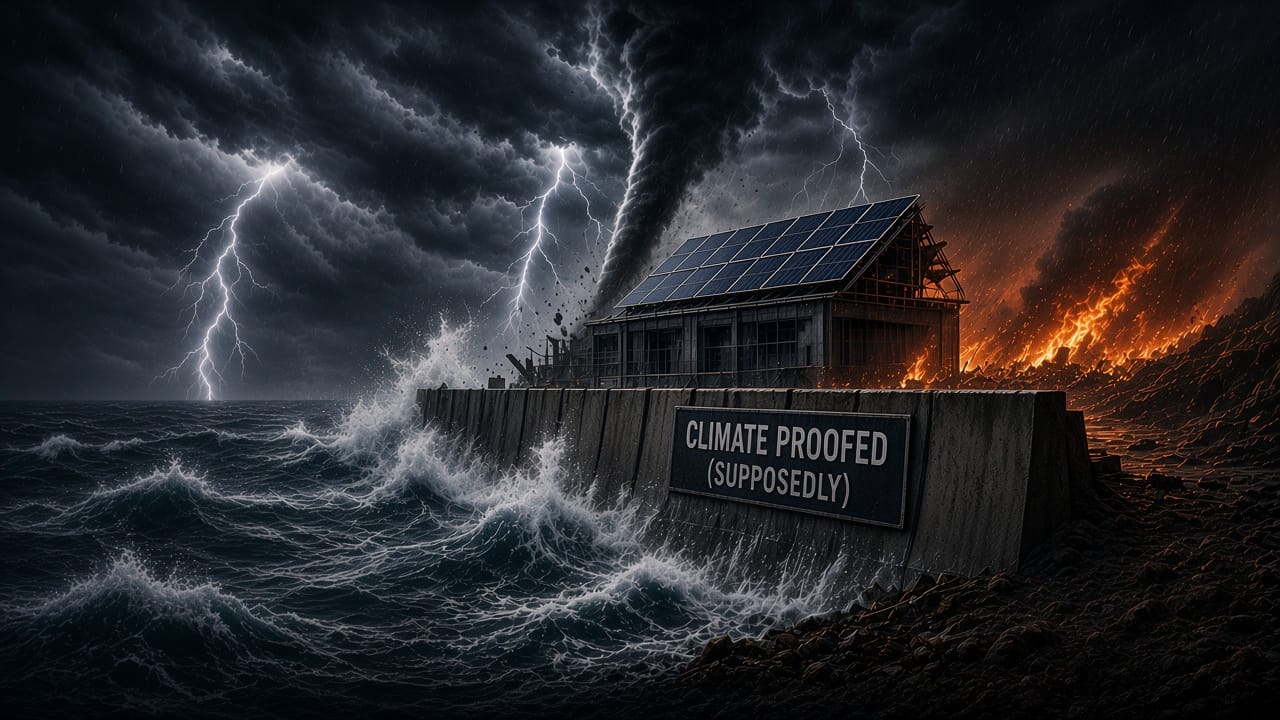
These findings strip “climate proofing” of any meaning. The term treats climate as a static design load rather than a non-stationary, incompletely understood, and partially irreversible process. It encourages the comforting illusion that sufficient concrete, higher seawalls, and updated building codes can create durable safety. In reality they might only buy time and reduce some risks under specific assumptions that are themselves increasingly fraying.
Climate proofing treats the future as a fixed design load that can be known, engineered against, and potentially recovered from. But as previously demonstrated none of those conditions hold. What is perhaps surprising is that they never did hold to begin with - not really. Whereas the remarkable and ontologically shocking recent works by the scientific community leave many questions to be answered, one of these questions is not about certainty. Climate scientists have always struggled to communicate our findings precisely because of the uncertainty attached to such findings. It is troubling that in such an environment, there were those who, despite protests, still insisted on promoting false narratives.
The concept therefore functions as a manmade illusion and a lie, and it always did. It converts uncertainty, underestimation, and irreversibility into a false promise of control. In doing so it risks locking societies into brittle investments, delaying the only intervention that still shapes the trajectory, and leaving communities more exposed precisely because they believed they had been made safe.
It is true that, particularly over the last decade, climate adaptation has often felt like a messy scramble for action at almost any cost, driven largely by an overwhelming sense of urgency. Genuine practitioners who have dedicated parts of their lives to helping communities prepare for and adapt to the real impacts of climate change deserve recognition, not blame. There are many such people. Those who actively pushed the “climate proofing” agenda, however, stand in a different category. By promoting a term that promised a false sense of durable protection (often to some of our most deprived and vulnerable communities) against a non-stationary and incompletely understood climate, they were disingenuous. They are responsible for that framing, and they should be held to account for it.
Talk to one of us. The first 30 minutes are on us.